
How to Build an Ideal
Customer Profile (ICP) That
Converts
Stop wasting pipeline on bad-fit accounts. Learn how top-performing B2B revenue teams build data-driven Ideal Customer Profiles that supercharge conversion rates and accelerate sales velocity.

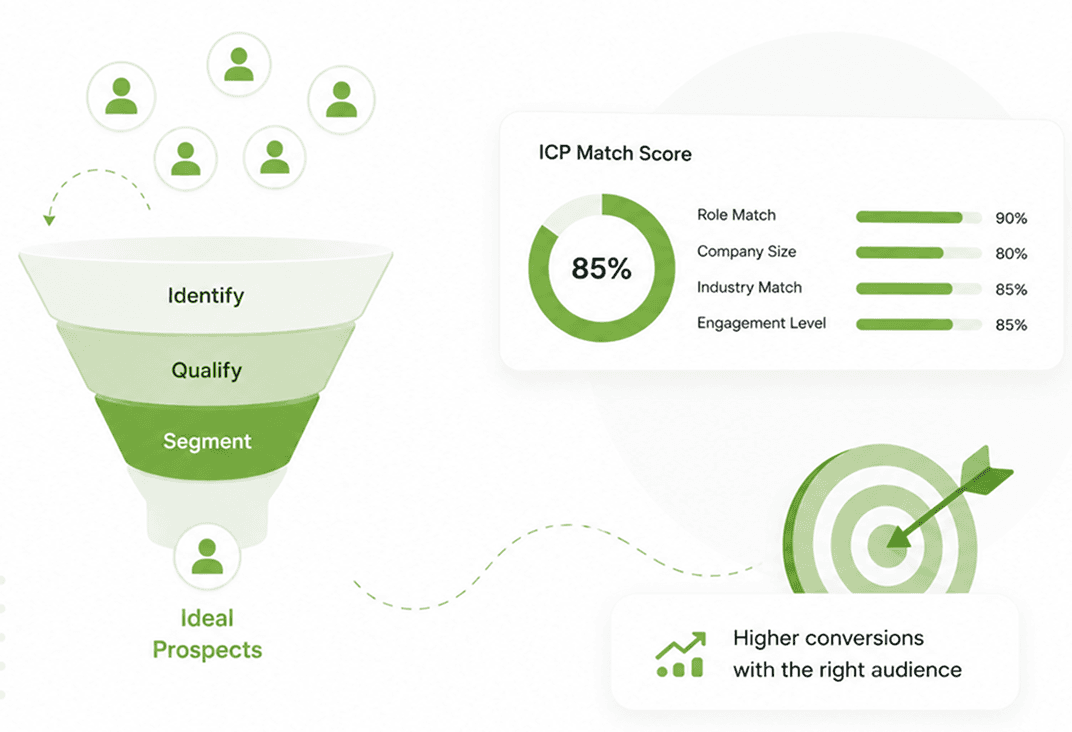
Every minute your sales team spends talking to an unqualified lead is revenue left on the table. In modern B2B SaaS, casting a wide net is a fast track to high churn, bloated customer acquisition costs (CAC), and burned-out reps.
The antidote isn't more cold emails or higher ad spend, it is precision. An Ideal Customer Profile (ICP) acts as the architectural blueprint for your entire go-to-market engine. When built correctly, it aligns marketing, sales, and product around the accounts that convert fastest, stay longest, and expand highest.
What is an ICP?
An Ideal Customer Profile (ICP) is a hypothetical description of the company type that derives the most value from your product - and, in return, provides the highest lifetime value
(LTV) to your business. Unlike buyer personas, which focus on the individual user, an ICP defines the macro organizational charateristics.
• “All B2B companies with 10-500 employees”
• Low conversion rates across campaigns
• Unpredictable sales cycles
• Series B/C Fintechs using AWS & Kubernetes
• 50-200 engineering headcount
• 3x faster sales velocity & high retention
ICP vs. Buyer Persona: Knowing the Difference
A common mistake is treating ICP and buyer personas as interchangeable. They serve completely different functions in
your outreach strategy.
Ideal Customer Profile (ICP)
Focuses on the company. Industry, revenue size,
tech stack, geography, compliance needs, and
growth rate.
Buyer Persona
Focuses on the human. Job title, daily pain points,
KPIs, personal objections, and buying committee
role.
Key Components of a High-Converting ICP
To make your ICP actionable for sales and marketing automation, it must be built on quantifiable pillars.
Firmographics
Company size, annual recurring revenue (ARR),
employee count, and geographical headquarters.
Technographics
Infrastructure software, cloud providers, APIs, and
legacy systems currently in use.
Trigger Events
Leadership changes, recent funding rounds,
geographic expansion, or regulatory shifts.
Behavioral Intent
Active search queries, content downloads, and
peer review site engagement spikes.
How to Build Your ICP: A 9-Step Framework
Follow this sequential roadmap to transition from gut-feeling guesswork to an empirical targeting engine.
Analyze Your Top 20% Customers
Look at clients with the highest retention, shortest sales cycle, and highest net revenue retention (NRR).
Segment by Revenue Contribution
Filter out customers who required excessive support tickets or churned within the first 6 months.
Identify Common Firmographic Traits
Extract overlapping characteristics in company size, industry vertical, and geographic location.
Audit Technographic Footprints
Determine what tools your champions integrate with daily to ensure seamless product compatibility.
Interview Your Customer Success Team
CS reps know who actually uses the product versus who bought it under pressure. Gather qualitative feedback.
Map Out Buying Committee Roles
Identify the economic buyer, champion, influencer, and technical evaluator for each target account.
Define Negative ICP Parameters
Explicitly list company types or industries your sales reps are forbidden from spending pipeline on.
Build Scoring Weights in CRM
Assign point values to firmographic and intent criteria to automate lead qualification scoring.
Iterate Quarterly with Revenue Data
Review conversion rates every 90 days with sales and marketing leadership to refine parameters.
Fit vs. Engagement Matrix
Not every prospect requires the same outreach approach. Use this matrix to prioritize your accounts based on ICP fit and engagement signals:
(ABM)
Common ICP Mistakes to Avoid
Building the ICP in a Silo
Creating an ICP without interviewing customer success and
sales reps leads to unrealistic assumptions.
Targeting Everyone
Saying “anyone who needs software” means your messaging
resonates with no one.
Ignoring Negative Churn Signals
Failing to analyze which customer segments churn the
fastest when defining parameters.
Never Updating the ICP
Treating your ICP as a one-time PDF document instead of a
living, breathing CRM filter.
Confusing Persona with ICP
Targeting job titles instead of company-level revenue and
technological compatibility.
Disregarding Regional Nuance
Assuming compliance and tech stacks are identical across
North America and EMEA markets.
Final Thoughts
Building an Ideal Customer Profile is the single highest-leverage exercise your revenue leadership team can undertake.
By narrowing your focus to accounts that genuinely match your product's superpower, you transform sales from a
numbers game into a predictable science.
“Precision in targeting beats volume in outreach every single time. Define your ideal customer clearly, and let your revenue engine do the rest.”